

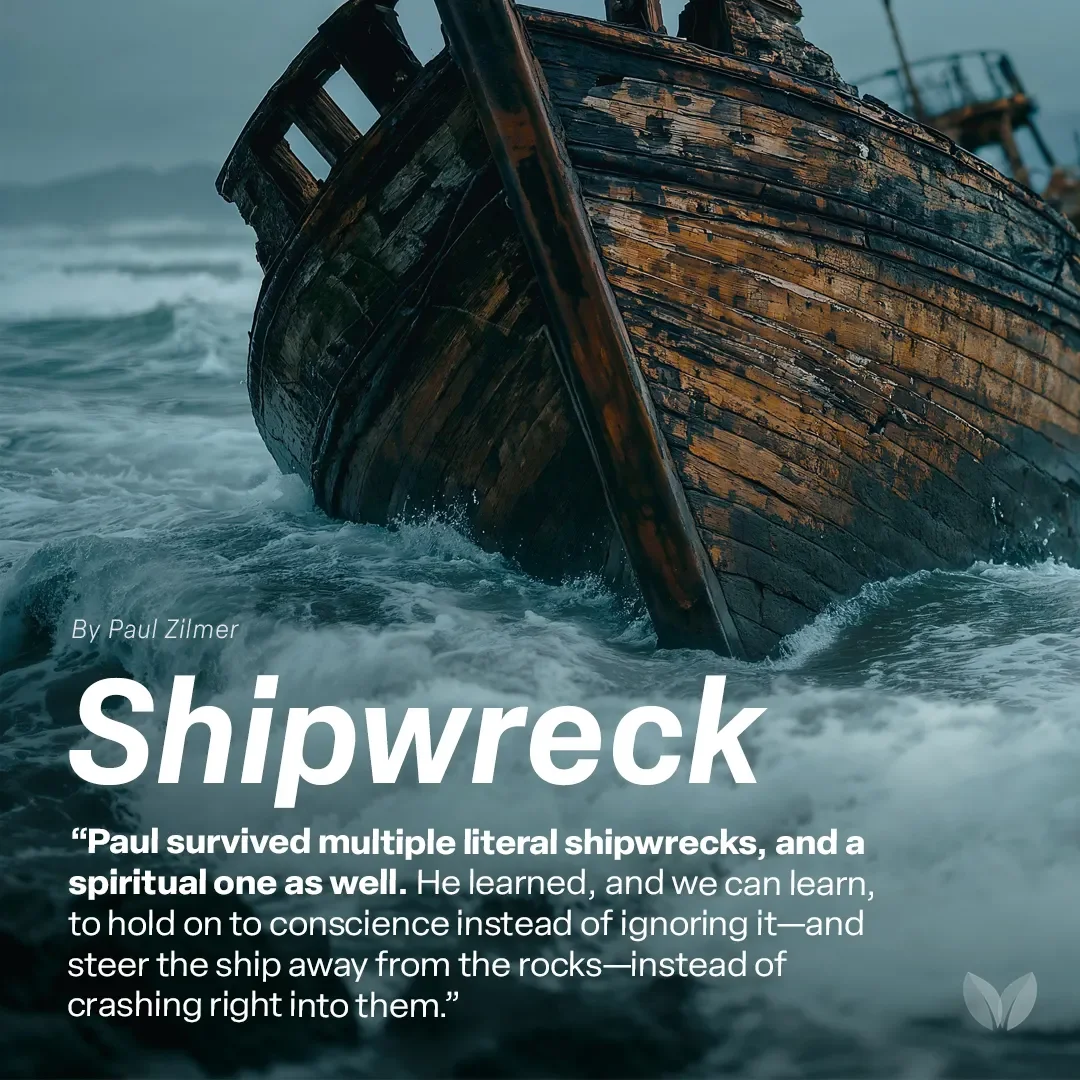
What comes into your mind when you hear the word “shipwreck”? It’s an event far beyond merely bad, it’s desperately bad. A disaster. Literal shipwrecks result in huge losses for the owners of the ship and cargo. Often, there is loss of life too. There may be no survivors at all.
When the word is used figuratively, we would expect it to convey that same sense of total disaster, loss, possible death.
The word appears twice in the New Testament. The first time, it’s used of literal wrecks of literal ships. In 2 Corinthians, responding to allegations that he’s not a “real” apostle, Paul catalogs some of the things he’s suffered in order to preach the gospel. He admits that he’s “talking like a madman”—he doesn’t like doing this, but feels compelled. In the middle of the catalog, he says, “Three times I was beaten with rods. Once I was stoned. Three times I was shipwrecked; a night and a day I was adrift at sea.” (2 Corinthians 11:25)
Can you imagine? Being shipwrecked three times? And this doesn’t even include the one shipwreck we have information about in Acts 27. That event hadn’t happened yet when he wrote 2 Corinthians. One of those wrecks left him adrift, presumably hanging onto some piece of wood, for a whole night then the whole following day. Any shipwreck poses life-threatening dangers, but in this one his survival would have been in serious doubt.
The second time this word appears, Paul uses it figuratively. By this time he has gone through that fourth (or more?) shipwreck of Acts 27. That wreck comes at the end of a two-week horrendous storm, during which, we’re told, “All hope of our being saved was at last abandoned.” (verse 20) Later, an angel assured Paul that they would in fact survive, and they did—but the ship was pounded to pieces and they all had to swim to shore in violent surf. The terror of that experience would be indelible.
So just think about what Paul has in mind when he writes this:
This charge I entrust to you, Timothy, my child, in accordance with the prophecies previously made about you, that by them you may wage the good warfare, holding faith and a good conscience. By rejecting this, some have made shipwreck of their faith. (1 Timothy 1:18-19)
Given his experiences, I don’t think Paul would use the word “shipwreck” casually. Shipwreck means terror, horrific loss, threat to life. Paul is trying to convey just how devastating, spiritually, it is to suppress conscience. Later in the letter, Paul talks about people abandoning the true faith, “whose consciences are seared.”
When our conscience tells us that something isn’t right, and we clamp a lid on it, and go ahead with what we want… Well, that’s something to take pretty seriously. It’s the mortal enemy of our faith.
Thankfully, some shipwrecks can be survived. Paul holds himself up as an example here as well. He confesses the wrongs he did when he was Saul the persecutor. It’s safe to say that his faith was shipwrecked, and he was operating within a system that had no place for faith, only rigid law. But look what the Lord Jesus was able to do with him! Paul survived multiple literal shipwrecks, and a spiritual one as well. He learned, and we can learn, to hold on to conscience instead of ignoring it—and steer the ship away from the rocks—instead of crashing right into them.
Love, Paul