

The religious environment Jesus grew up in, lived his whole life in, preached and taught in, was very concerned with “cleanness” and “uncleanness”. Among the religious leadership, it was an obsession.
Their concern came directly out of the Law of Moses. The Law meticulously detailed which animals were clean and could be eaten, and which were unclean and must not be eaten. The entirety of Leviticus 11 is devoted to the details, and Moses repeats much of it again in Deuteronomy 14.
To all appearances, Jesus comes along and shreds this commandment:
“There is nothing outside a person that by going into him can defile him, but the things that come out of a person are what defile him.”… “Whatever goes into a person from outside cannot defile him, since it enters not his heart but his stomach, and is expelled?” (Thus he declared all foods clean.) (Mark 7:15-19)
This seems to directly contradict what Jesus says of himself with regard to the Law:
“Do not think that I have come to abolish the Law or the Prophets; I have not come to abolish them but to fulfill them. For truly, I say to you, until heaven and earth pass away, not an iota, not a dot, will pass from the Law until all is accomplished. Therefore whoever relaxes one of the least of these commandments and teaches others to do the same will be called least in the kingdom of heaven, but whoever does them and teaches them will be called great in the kingdom of heaven. (Matthew 5:17-19)
In Mark’s account, doesn’t Jesus abolish the law regarding what is unclean to eat? Doesn’t he relax the commandment, and teach others to do the same?
Let’s read carefully. Jesus puts forward two ways the Law can be set aside. The Law could be abolished, or the Law could be fulfilled. Either way it’s no longer in effect. Jesus goes on to give several examples of how he fulfills the Law. In each he declares, “You have heard that it was said…but I say to you.” The Law dealt with technical, external compliance. Jesus teaches us that this kind of religion is now superseded by internal reformation, in the heart.
Israel was commanded to be separate in many ways from the nations around them. Making distinction between clean and unclean food was part of it. The point is stated clearly:
You shall therefore separate the clean beast from the unclean, and the unclean bird from the clean… You shall be holy to me, for I the LORD am holy and have separated you from the peoples, that you should be mine. (Leviticus 20:25-26)
The technical, external, and ultimately unimportant dietary distinction of “clean” and “unclean” was a teaching device, a parable they were to live out. The meaning of it was that they were to be holy to the Lord. When Jesus comes along, the commandment is fulfilled, not abolished. The fulfillment is that, in Christ, we are set apart and holy. Internally.
Immediately following the declaration that all foods are clean, Mark records that Jesus leaves his Jewish homeland and goes into Phoenicia, where he heals the daughter of a Gentile woman. He then travels to the Decapolis, healing and preaching in an area of mixed Jewish and (majority) Gentile population. It’s apparently here that he performs the feeding of the four thousand, which would have included Gentiles.
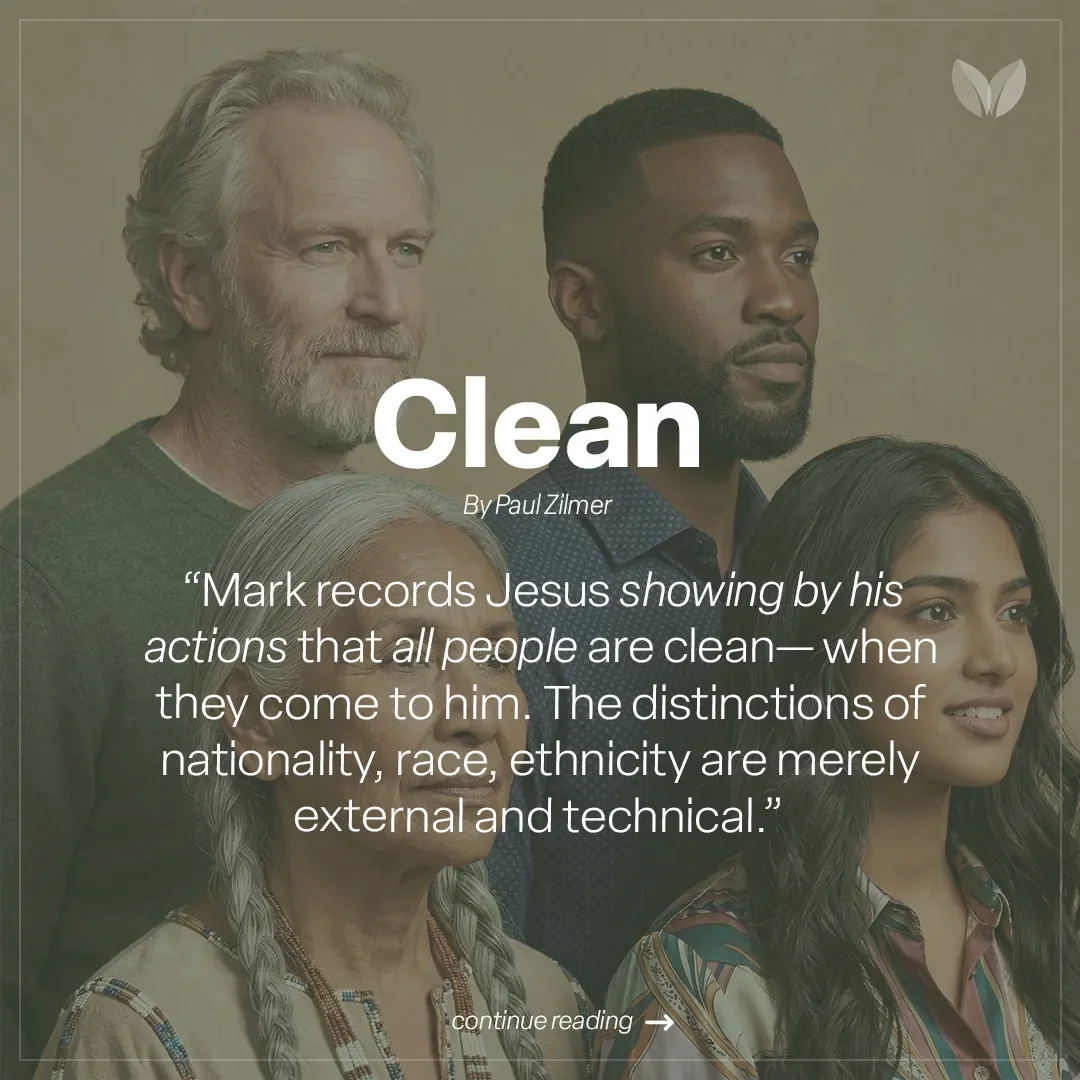
Mark’s arrangement isn’t accidental. On the heels of declaring all foods clean, Mark records Jesus showing by his actions that all people are clean—when they come to him. The distinctions of nationality, race, ethnicity are merely external and technical. Those distinctions are eradicated in Jesus Christ. They mean nothing to him, and mean nothing to us. What matters is internal reformation.
Love, Paul