

Children
Here’s one you know the answer to. Is it a good thing to be childlike? Of course you got it. Jesus says it’s more than good—it’s essential:
And calling to him a child, he put him in the midst of them and said, “Truly, I say to you, unless you turn and become like children, you will never enter the kingdom of heaven. Whoever humbles himself like this child is the greatest in the kingdom of heaven.” (Matthew 18:2-4)
But Jesus called them to him, saying, “Let the children come to me, and do not hinder them, for to such belongs the kingdom of God.” (Luke 18:16)
But (and you may have thought about this yourself) Paul and the writer of the Hebrews letter actually criticize childlikeness:
When I was a child, I spoke like a child, I thought like a child, I reasoned like a child. When I became a man, I gave up childish ways. (1 Corinthians 13:11)
[He gave gifts so] we all attain to the unity of the faith and of the knowledge of the Son of God, to mature manhood, to the measure of the stature of the fullness of Christ, so that we may no longer be children. (Ephesians 4:13-14)
For though by this time you ought to be teachers, you need someone to teach you again the basic principles of the oracles of God. You need milk, not solid food, for everyone who lives on milk is unskilled in the word of righteousness, since he is a child. But solid food is for the mature, for those who have their powers of discernment trained by constant practice to distinguish good from evil. (Hebrews 5:12-14)
Even Jesus himself notes how children tend to behave in ways that aren’t commendable. He says his opponents reflect this aspect of child behavior:
But to what shall I compare this generation? It is like children sitting in the marketplaces and calling to their playmates, “We played the flute for you, and you did not dance; we sang a dirge, and you did not mourn.” (Matthew 11:16-17)
What are we to make of all this? Paul, I think, resolves the apparent discrepancy:
Brothers, do not be children in your thinking. Be infants in evil, but in your thinking be mature. (1 Corinthians 14:20)
When we look at more passages that talk about us as “children”—in the writings of Peter and John and quite a few others by Paul himself—a fuller picture emerges. The answer to the original question is: In some ways, yes—be children. But kids aren’t perfect, are they? They can be cruel, they lack experience and good judgment, they act in inappropriate ways. Sometimes they are rebellious, disobedient to any sort of moral standard or restraint, even to their own hurt.
What do parents want for their children? They want them to grow up. We are repeatedly reminded that we are the children of God. Whatever we were like in our prior life, we are told that in belief and baptism we are “born again”. We go back to being infants, spiritually. “To such belongs the kingdom of God,” Jesus says. But we aren’t to stop there. Our Father wants to see us grow up, “to mature adulthood”. Even, eventually, “to the measure of the stature of the fullness of Christ”.
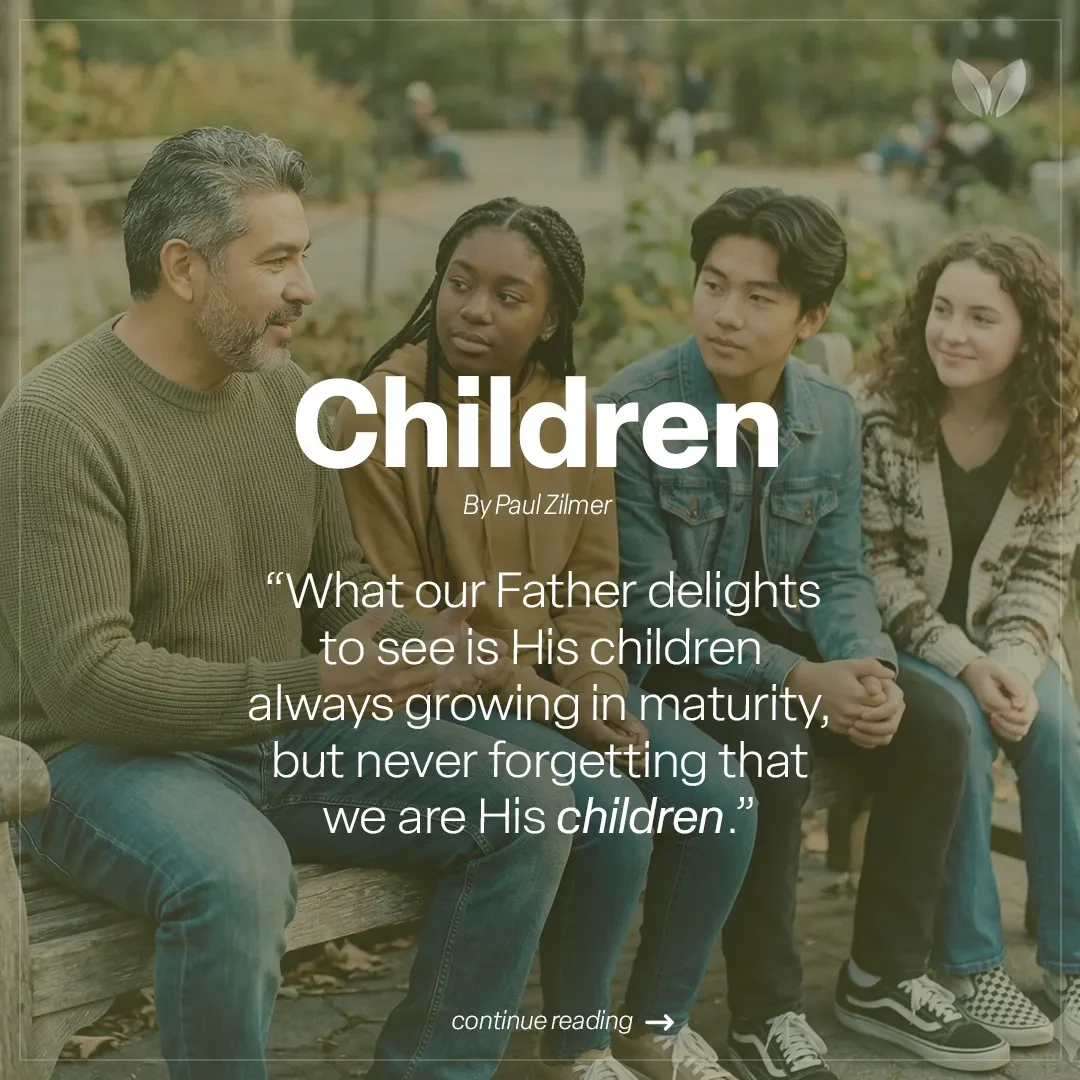
Seems like an impossible goal. Which doesn’t mean we give up and simply remain “children in our thinking”. It takes a lifetime for true spiritual children to grow up. What our Father delights to see is His children always growing in maturity, but never forgetting that we are His children.
Love, Paul