

Apocalypse
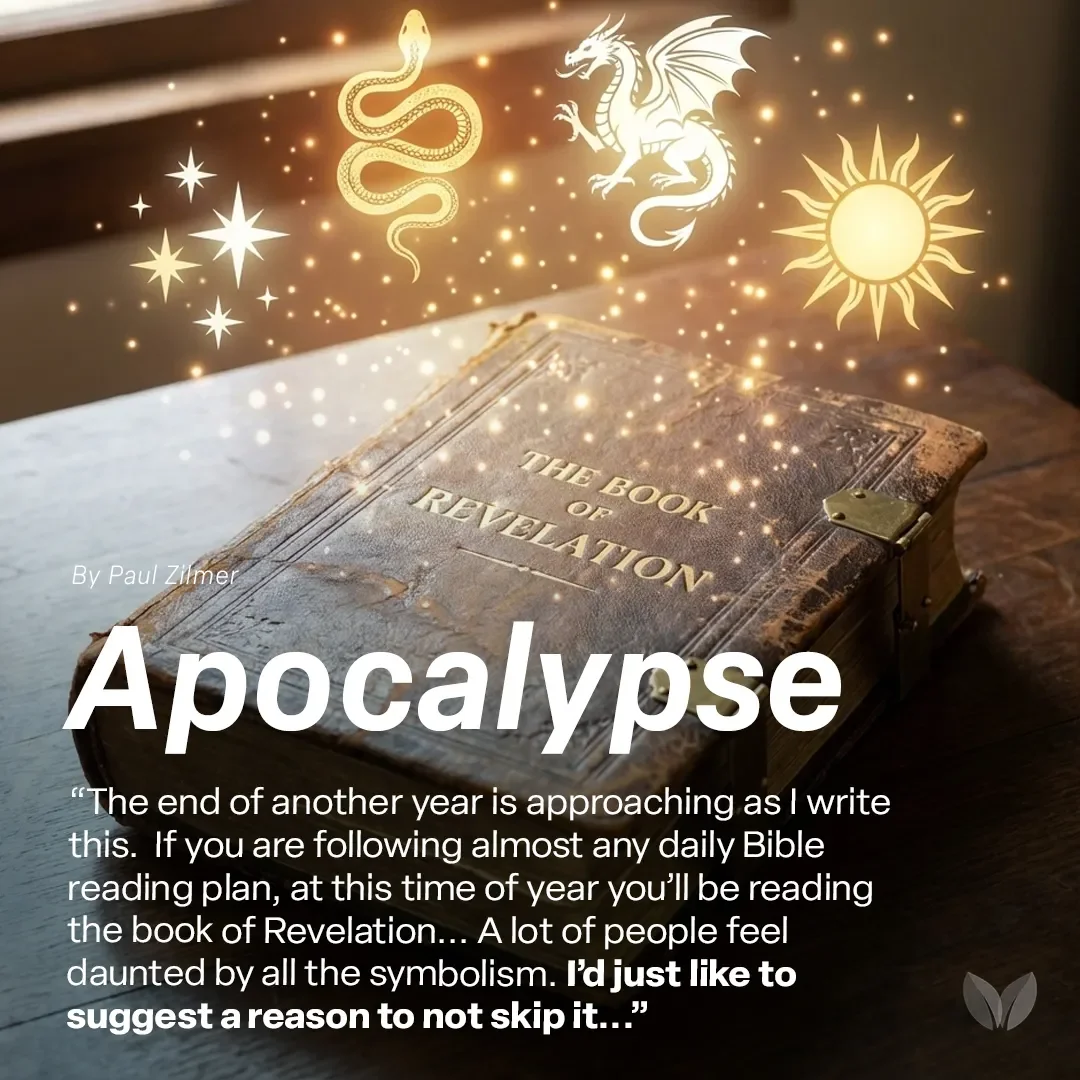
The end of another year is approaching as I write this. If you are following almost any daily Bible reading plan, at this time of year you’ll be reading the book of Revelation. Or—unfortunately—you may be skipping it. A lot of people feel daunted by all the symbolism. I’d just like to suggest a reason to not skip it.
What does the word “revelation” mean? It means revealing something, right? In the Greek of the New Testament, the first word of the book is apokalupto – the verb form of apokalupsis, the word that has come into our language as “apocalypse”. This word literally means to take the cover off, to reveal. It is sad that what Jesus intends as a revealing should mostly be thought of as impenetrable, impossible to make sense of except by experts.
The very word itself, in common English usage, is far from Jesus’s original intent. Here’s a dictionary definition of what the word means in English-speaking popular culture:
the complete final destruction of the world, as described in the biblical book of Revelation.
an event involving destruction or damage on an awesome or catastrophic scale.
Does that sound about right, what most people think? Hopefully, as Bible students, we see that the first definition arises from a completely false concept of what the book of Revelation is about. But sadly, the word that actually means “revelation” has come to mean “complete final destruction”.
It’s of course true that there are a lot of pictures of God’s judgments. But nowhere does the book describe “complete final destruction of the world”. The actual ending is the complete opposite of that! You may struggle to know what is meant by the seven seals on the scroll, the seven trumpets, the seven bowls of God’s wrath, the beasts. The judgments described are indeed severe. But just look at how they end!
The sixth seal concludes with a vision of a multitude clothed in white, serving God forever, “and God will wipe away every tear from their eyes.” This is Kingdom language. The seventh seal then ushers in the trumpets. (Rev 7:9-17)
“Then the seventh angel blew his trumpet, and there were loud voices in heaven, saying, ‘The kingdom of the world has become the kingdom of our Lord and of his Christ, and he shall reign forever and ever.’ ” (Rev 11:15) Explicitly, this is the Kingdom.
“The seventh angel poured out his bowl into the air, and a loud voice came out of the temple, from the throne, saying, ‘It is done!’ And there were flashes of lightning, rumblings, peals of thunder, and a great earthquake such as there had never been since man was on the earth, so great was that earthquake.” (Rev 16:17-18) That earthquake is associated in a number of places with the return of Christ. “It is done,” was spoken by Jesus on the cross at the completion of his first work, atoning for sin. Now it is the arrival of the King and his second great work. There are judgments described on those who reject his kingship: “They will make war on the Lamb, and the Lamb will conquer them, for he is Lord of lords and King of kings, and those with him are called and chosen and faithful.” (Rev 17:14) “Those with him,” that’s us!
And when all of this is done, there’s the Marriage Supper of the Lamb, and blessed are those who are invited. (Rev 19:6-10)
Complete final destruction of the world? Far from it! The ending is the glorious Kingdom of God. Which does include the removal of all the evils mankind has perpetrated, and removal of the perpetrators if they do not “wash their robes and make them white in the blood of the Lamb.” But is our focus on the judgments, however just they may be? Our focus, surely, should be on the depictions of Christ reigning, God’s glory filling the earth, the resurrection and bestowal of eternal life on the faithful.
Notice, to benefit from the book we don’t have to figure out what is meant by the beasts and all the rest. It’s not wrong to dig into that, certainly—Jesus provided all of it to instruct us. But we don’t need to avoid the Apocalypse just because of the symbols. We can gain wonderful encouragement from this book, gain confidence that whatever happens in the world, the ending is the glory of the Kingdom. This powerful reminder is one very good reason not to skip the book. Thus encouraged, with our whole heart we can join John at the end, saying, “Amen. Come Lord Jesus!”
Love, Paul